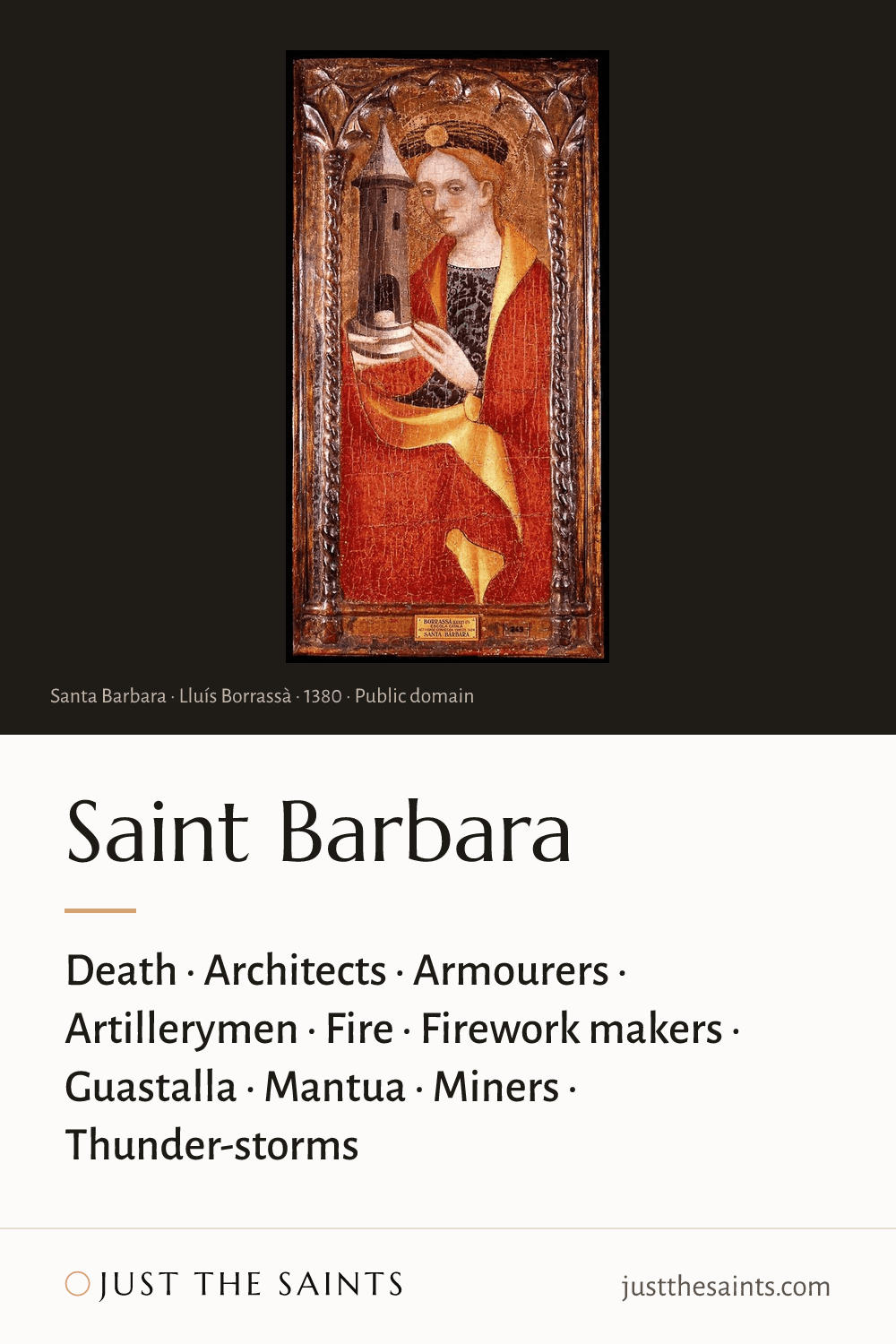
Saint Barbara
Updated
In our own words
There is no reference to St. Barbara in the authentic early historical authorities, but her veneration was common from the seventh century. According to legendary Acts, she was the daughter of a rich heathen named Dioscorus, who kept her shut up in a tower. In them, she acknowledged herself to be a Christian, and the prefect Martinianus condemned her to death by beheading. The emperor of her martyrdom is sometimes called Maximinus and sometimes Maximianus. The traditions vary as to the place, Heliopolis in Egypt or Nicomedia. Her feast falls on 4 December.
Virgin and Martyr.
Patronages on this page:
Patronages
According to Catholic tradition, as recorded in the sources cited for each patronage:
Architects
Recorded as patron of architects in:
- Drake, Saints and Their Emblems, 1916, PATRONS OF ARTS, TRADES AND PROFESSIONS
Armourers
Recorded as patron of armourers in:
- Drake, Saints and Their Emblems, 1916, PATRONS OF ARTS, TRADES AND PROFESSIONS
Also recorded as patron:
Artillerymen
The legend that her father was struck by lightning caused her, probably, to be regarded by the common people as the patron saint in time of danger from thunder-storms and fire, and later by analogy, as the protector of artillerymen and miners.
Recorded as patron of artillerymen in:
- Catholic Encyclopedia, 1913, St. Barbara
- Drake, Saints and Their Emblems, 1916, PATRONS OF ARTS, TRADES AND PROFESSIONS
Death
himself to the intercession of St. Barbara, who is particularly invoked in the northern kingdoms, for the grace of a happy death and the benefit of receiving the last sacraments.
Recorded as patron of death in:
- Butler, Lives of the Saints, 1812, ST. STANISLAS KOSTKA, C.
On Just the Poems: Poems About Death
Also recorded as patron:
Fire
The legend that her father was struck by lightning caused her, probably, to be regarded by the common people as the patron saint in time of danger from thunder-storms and fire, and later by analogy, as the protector of artillerymen and miners.
Recorded as patron of fire in:
Firework makers
Recorded as patron of firework makers in:
- Drake, Saints and Their Emblems, 1916, PATRONS OF ARTS, TRADES AND PROFESSIONS
Guastalla
Recorded as patron of Guastalla in:
- Husenbeth, Emblems of Saints, 1882, PATRONS OF COUNTRIES AND CITIES.
Also recorded as patron:
Mantua
Recorded as patron of Mantua in:
- Husenbeth, Emblems of Saints, 1882, PATRONS OF COUNTRIES AND CITIES.
Also recorded as patron:
Miners
The legend that her father was struck by lightning caused her, probably, to be regarded by the common people as the patron saint in time of danger from thunder-storms and fire, and later by analogy, as the protector of artillerymen and miners.
Recorded as patron of miners in:
Also recorded as patron:
Thunder-storms
The legend that her father was struck by lightning caused her, probably, to be regarded by the common people as the patron saint in time of danger from thunder-storms and fire, and later by analogy, as the protector of artillerymen and miners.
Recorded as patron of thunder-storms in:
Feast day
- December 4 · Traditional date, Catholic Encyclopedia, 1913
From Catholic Encyclopedia, 1913, “St. Barbara”
There is no reference to St. Barbara contained in the authentic early historical authorities for Christian antiquity, neither does her name appear in the original recension of St. Jerome's martyrology.
Veneration of the saint was common, however, from the seventh century.
At about this date there were in existence legendary Acts of her martyrdom which were inserted in the collection of Symeon Metaphrastes and were used as well by the authors (Ado, Usuard, etc.)
of the enlarged martyrologies composed during the ninth century in Western Europe.
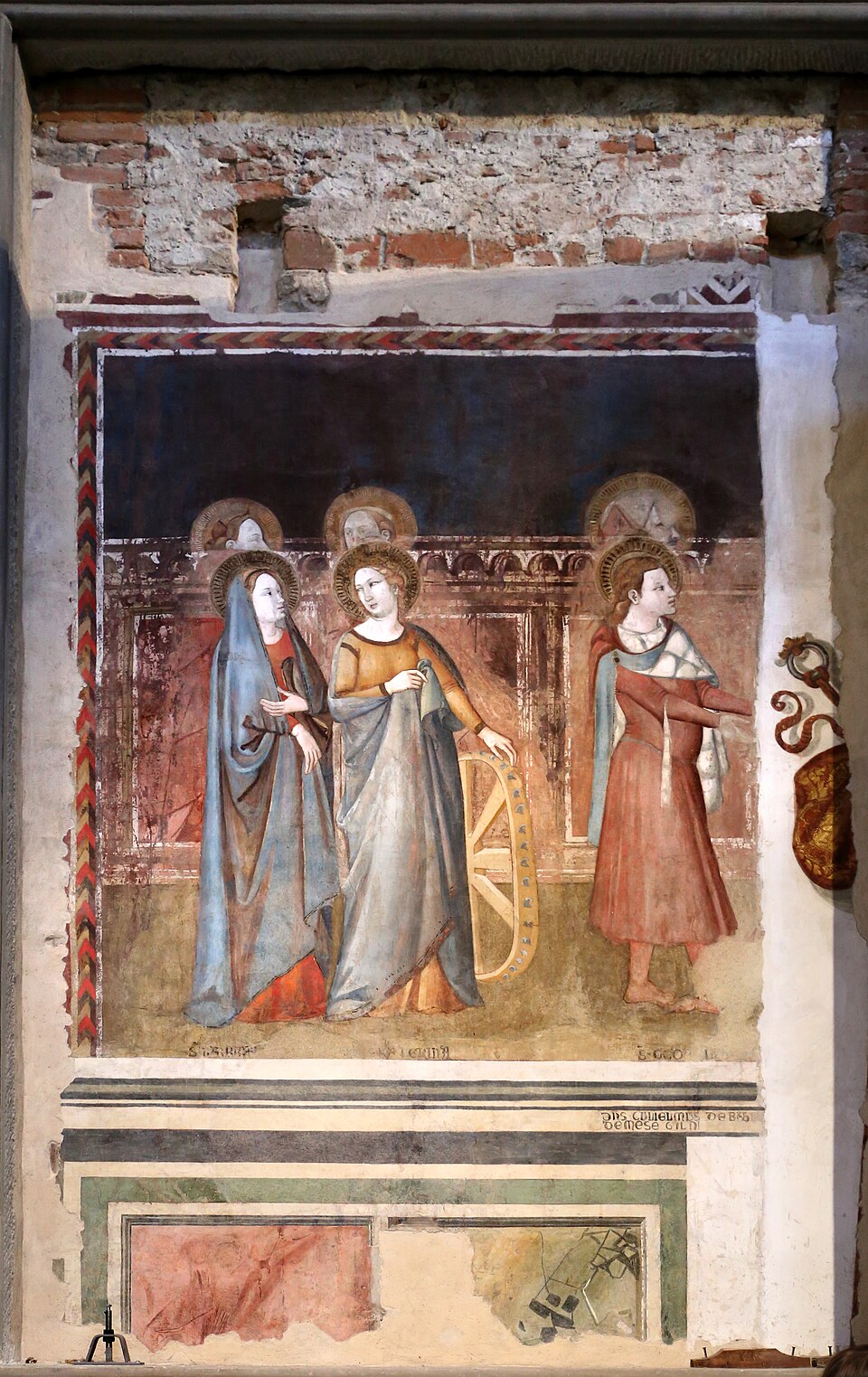
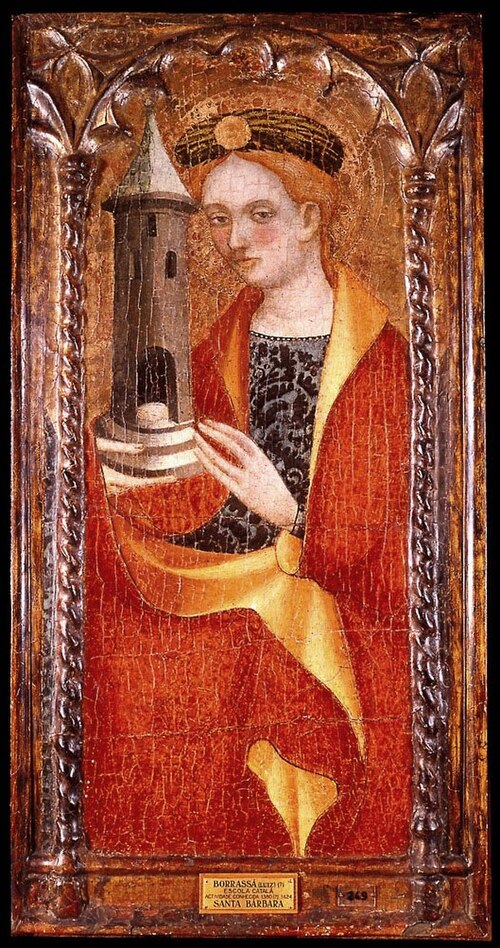
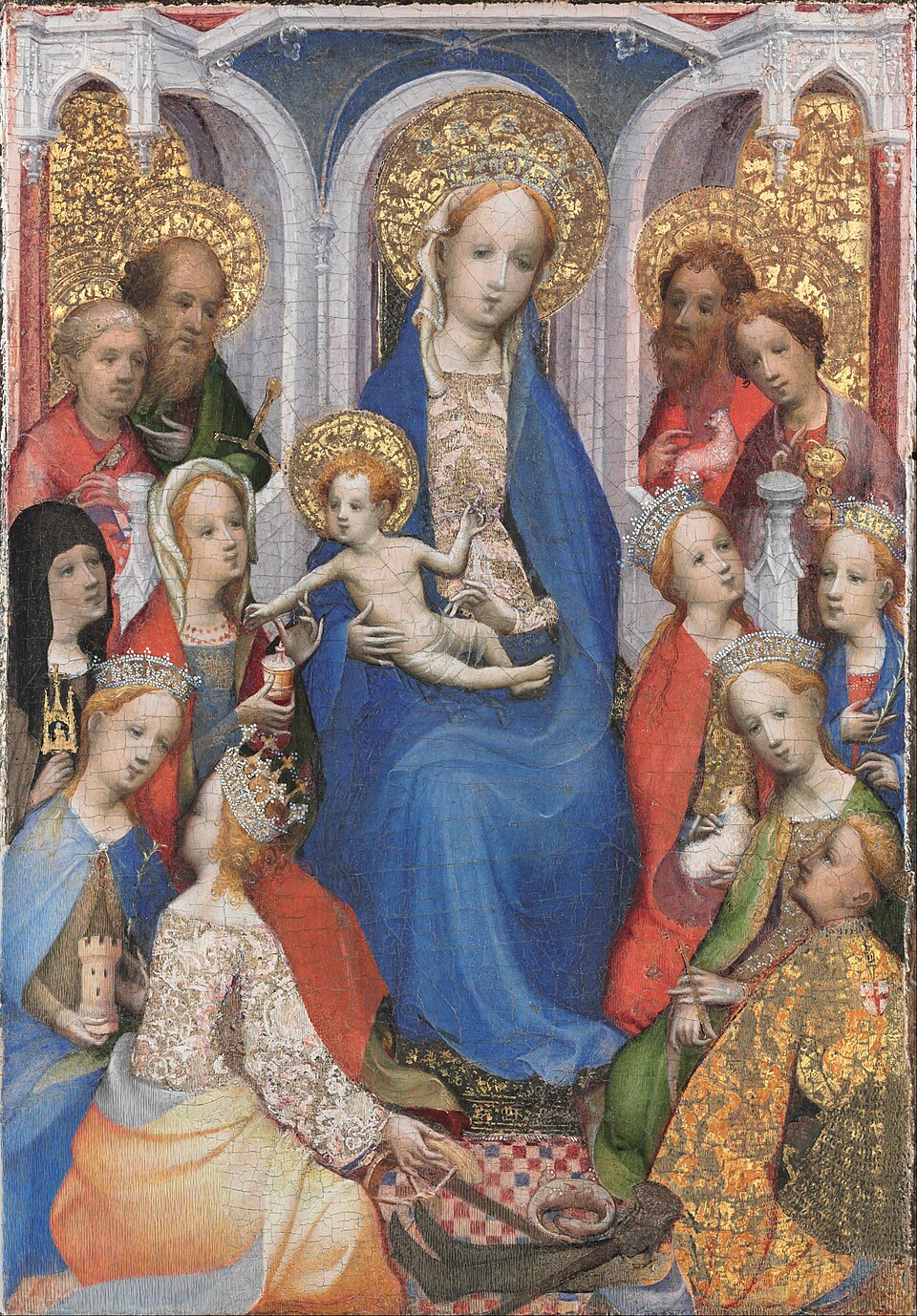
Works of art

Share this page