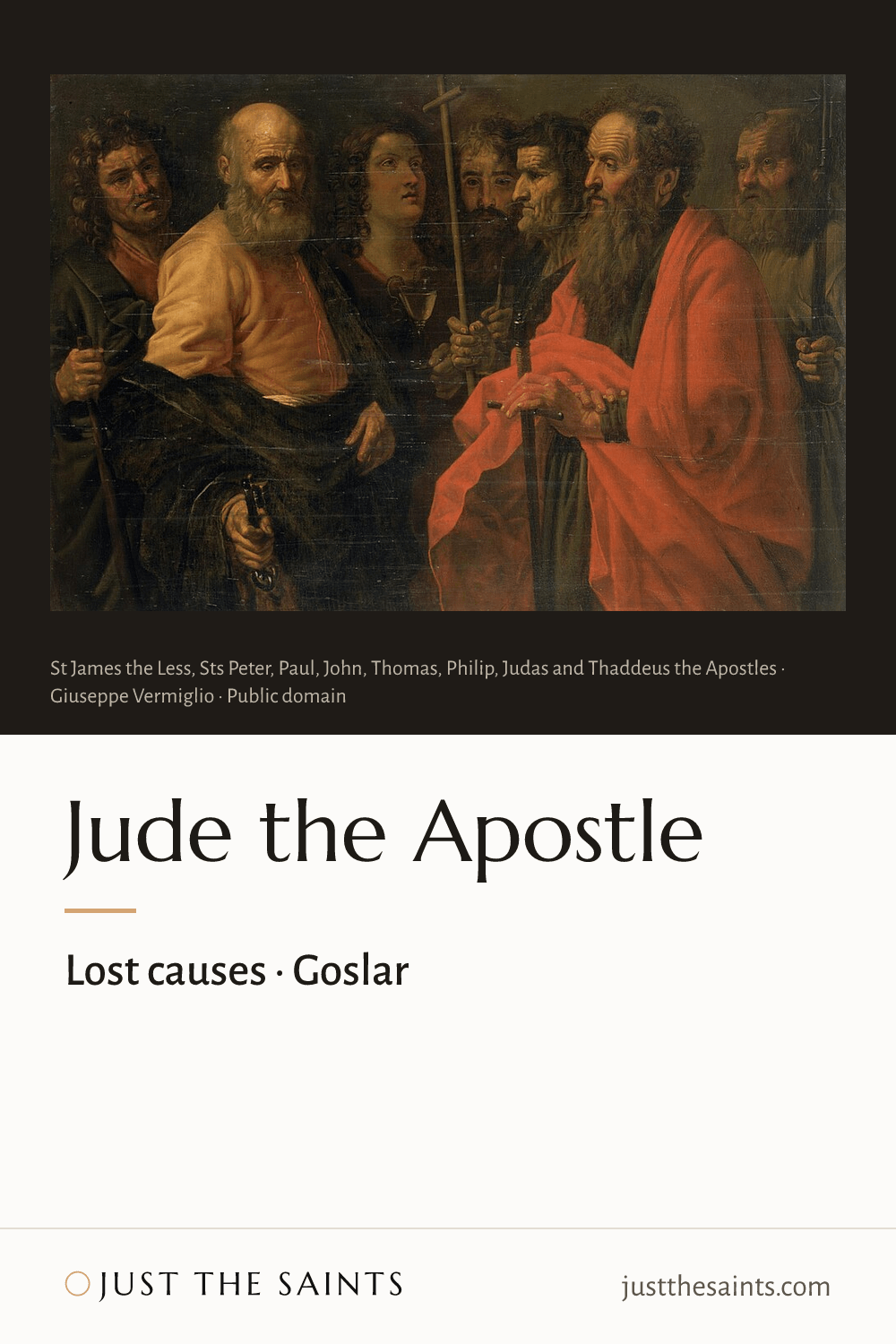
Jude the Apostle
Updated
In our own words
The gospels say nothing of Jude before they list him among the apostles. After the Last Supper he asked Jesus why he did not show himself to the world. The martyrologies say he preached in Judaea, Samaria, Idumaea and Syria, above all in Mesopotamia. He came back to Jerusalem in the year 62, after his brother James was martyred, and wrote a general epistle to the churches of the East. Western martyrologies say he died a martyr in Persia; some Greeks place his death in Armenia. He shares his feast with Simon on 28 October. A modern prayer links him to lost causes.
The apostle St. Jude is distinguished from the Iscariot, by the surname of Thaddæus, which signifies in Syriac, praising or confession, (being of the same import with the Hebrew word Judas,) also by that of Lebbæus, which is given him in the Greek text of St. Matthew;
From Butler, Lives of the Saints, 1812, “ST. JUDE, APOSTLE.”
Patronages on this page:
Patronages
According to Catholic tradition, as recorded in the sources cited for each patronage:
Goslar
Recorded as patron of Goslar in:
- Husenbeth, Emblems of Saints, 1882, PATRONS OF COUNTRIES AND CITIES.
Lost causes
- Archdiocese of Saint Paul and Minneapolis: Prayer to St. Jude for Lost Causes, consulted October 4, 2026
Feast day
- October 28 · General Roman Calendar
From Butler, Lives of the Saints, 1812, “ST. JUDE, APOSTLE.”
that word signifying, according to St. Jerom, a man of wit and understanding, from the Hebrew word Leb, a heart;
though it might equally be derived from the Hebrew word, which signifies a Lion.
St. Jude was brother to St. James the Less, as he styles himself in his epistle;
likewise of St. Simeon of Jerusalem, and of one Joses," who are styled the brethren of our Lord, and were sons of Cleophas, and Mary, sister to the Blessed Virgin.
Works of art
Share this page